
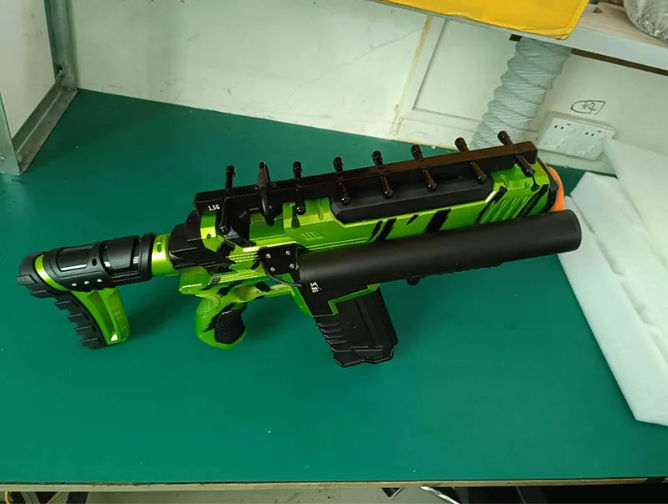
Security details that handle executive protection now face an aerial problem their ground procedures never covered: a camera drone hovering over a residence, a racing quad trailing a motorcade, or an unidentified aircraft circling a public appearance. This guide defines a workable VIP protection protocol built around a handheld anti drone gun, covering threat assessment, team roles, engagement rules and the equipment specifications that make rapid response realistic.
Protective details plan against surveilled approaches, vehicle ambushes and crowd threats, yet a 2 kg consumer drone can photograph a residence from 120 meters, hover above a garden event or drop a payload with almost no warning. The threat is asymmetric: the aircraft is cheap, quiet and legally ambiguous, while the protected person is fixed and predictable. A written protocol changes that balance. It assigns who looks up, who decides and who engages, so the response to a drone incursion is rehearsed rather than improvised. For VIP protection work, the goal is not to destroy the aircraft but to break its radio links, force a failsafe and clear the camera out of the airspace in seconds.
A field-tested protocol runs five steps. One, detection: a designated observer runs continuous drone detection with a handheld RF detector or fixed sensor, scanning for the control and video signals every drone must emit. Two, confirmation: the observer classifies the contact by band and behavior, separating an errant hobby flight from a deliberate approach. Three, decision: the detail leader authorizes engagement under pre-agreed rules, because waiting for a committee decision costs the one thing a detail cannot buy back, time. Four, engagement: the operator shoulders the anti drone gun, selects the matching channels and transmits until the aircraft triggers its failsafe. Five, documentation: the log records timestamps, frequency bands, channel settings and the outcome of the engagement, which protects the client and the security team legally in any later inquiry or insurance claim. End to end, a drilled crew completes this rapid response loop in well under a minute.
Equipment choice decides whether the protocol works. A representative six-channel handheld unit covers 430-450, 860-930, 1160-1280, 1560-1620, 2380-2470 and 5725-5850 MHz with 10-30 W per channel, enough to address positioning, control and video links on both consumer and modified aircraft. Weight matters for a walking VIP protection detail: keep the anti drone gun at or below 10 kg with a shoulder-sling carry. Battery endurance around 30 minutes of continuous transmission covers a public appearance, with hot-swappable spares for longer assignments. IP65 sealing and a -30 to +70 degree Celsius operating range keep the unit working through rain and summer heat. Finally, verify that the hardware sustains at least 15 simultaneous targets, because a swarm of cheap quadcopters is now a documented tactic at public events.
Hardware fails without drills. Assign three roles: the drone detection observer, the engagement operator and the detail leader who owns the decision. Rehearse the handoff so the observer's call sign, bearing and band estimate reach the operator without radio clutter. Run monthly live exercises with a training drone at decreasing distances, recording detection range, confirmation time and time-to-failsafe. After each event, review whether the rapid response sequence held or stalled, and adjust the rules of engagement with legal counsel, since RF transmission permits differ by market and by agency.
During a product launch appearance, a protection detail stationed a two-person aerial cell on the venue rooftop. Twenty minutes into the event, the handheld detector flagged a rising 2.4 GHz control link at roughly 800 meters. The observer confirmed a quadcopter approaching the stage line, the detail leader authorized engagement, and the operator fired the positioning and control channels of the anti drone gun. The aircraft entered return-to-home within seconds and left the venue airspace. The whole engagement, from detection to documented outcome, took under ninety seconds and passed without interrupting the client's schedule. The VIP protection plan was credited in the after-action review precisely because every step had been rehearsed.
Procurement Checklist and Common Questions
Before issuing equipment, verify channel independence, per-channel output power, stated range under realistic conditions and the battery swap workflow. Confirm with counsel which agencies may legally operate RF countermeasures in your market, and complete any licensing before the first deployment.
How far can a handheld anti drone gun reach during VIP protection duty?
Against mainstream consumer aircraft, effective range is typically 1-3 km, shortened by cluttered RF environments or frequency-hopping targets, so request per-channel test data rather than a single headline number.
Does engaging a drone require special authorization?
Yes. RF countermeasures are regulated in most markets. Build the license or agency-coordination step into the protocol before the security team ever deploys.
Can one operator handle detection and engagement alone?
A single operator can manage short engagements, but the reliable standard is three roles, because drone detection, decision-making and transmission each demand full attention during rapid response work with an anti drone gun.


