
Buyers comparing anti drone systems usually start from one number: how far out can a threat be stopped? The honest answer is that stopping a drone far from the perimeter is never a single device but a chain of detection, classification and engagement, and each stage has its own reach. This guide explains how RF based anti drone systems deliver long range drone interception, what each stage contributes, and which specifications deserve scrutiny before purchase.
An aircraft must be found before it can be stopped. Modern drone detection combines radar, RF direction finding and optical confirmation, and the detection ring is the widest layer of any deployment: a representative fixed detection unit tracks standard consumer aircraft at 3-10 km and locates the pilot's position as well. RF sensors listen for the control and video links that every drone must emit on known RF bands, classify the model by protocol fingerprint, and push bearing and distance to the command console. For buyers planning long range coverage, detection range rather than jamming radius sets the size of the protected area, because engagement hardware can only act on contacts the sensors have already found.
Raw detections mean little without classification. RF based anti drone systems sort contacts by RF bands and protocol signature: a standard 2.4 GHz consumer link, a 5.8 GHz racing video feed, or a modified aircraft on 1.2 GHz. That judgment is what turns distant contacts into defensible long range decisions rather than reactions. Whitelisted aircraft flying an agreed survey route can be logged and ignored, while an unknown contact closing on the perimeter triggers engagement. Systems built to handle at least 15 simultaneous targets keep this decision quality intact during swarm-style incidents, when dozens of contacts appear at once and operator attention is the scarcest resource.
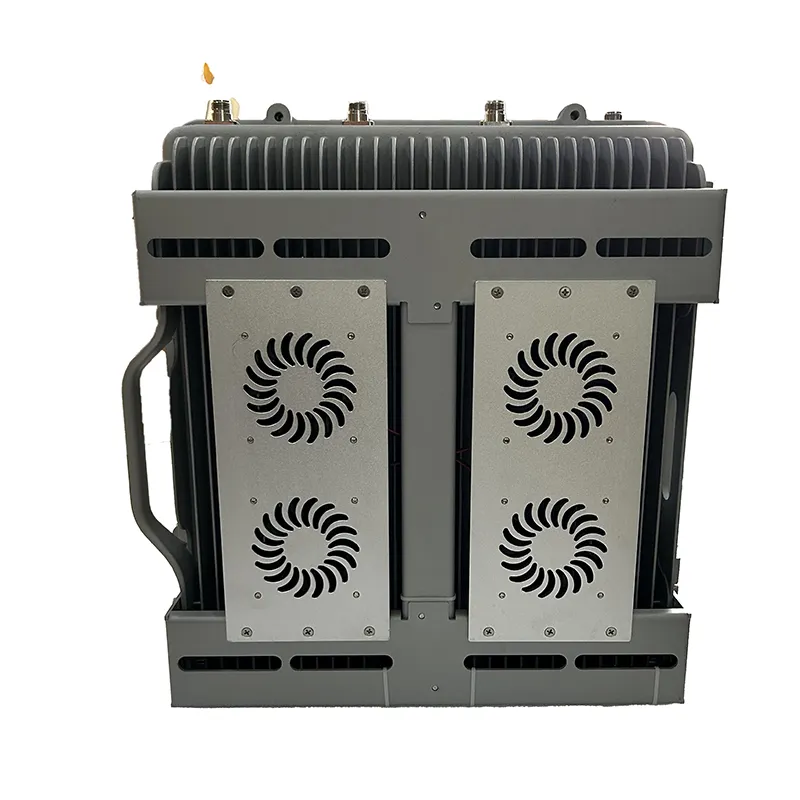
Engagement hardware comes in three ranges. Handheld guns reach 1-3 km against mainstream aircraft and serve as the last line for close protection. Fixed suppression systems are the long range workhorses: a 32-channel unit covering RF bands from 220 MHz to 5.86 GHz with customizable band plans sustains a 2-3 km jamming radius, enough to blanket a full perimeter from a single mast. Vehicle-mounted platforms pair a 3 km reach with 5 km passive detection and operate at convoy speeds up to 150 km/h, extending interception along roads and borders. Buyers should treat vendor range claims as conditional: distance shrinks against hardened or frequency-hopping targets and in cluttered RF environments, so request per-band test data rather than a single headline number.
The strongest deployments stack the stages. An outer drone detection ring at 3-10 km provides early warning and pilot locating. A mid-layer of fixed jammers with a 2-3 km jamming radius handles confirmed threats at standoff distance. Handheld units cover the inner zone for anything that penetrates. Across all three layers, the RF bands in use should be customizable, because regional drone markets use different frequencies and modified aircraft deliberately avoid the most common ones. Systems whose band edges can be tuned from 220 MHz up to 5.86 GHz let operators adapt coverage as threats evolve, without replacing hardware.
A photovoltaic plant operator covering four square kilometers deployed a layered RF based solution. Two fixed detection units created a 6 km warning ring. A 32-channel suppression system on a central mast held a 2.5 km jamming radius over the entire site, and a vehicle-mounted unit patrolled the access road. During a night intrusion, the detection ring located the aircraft and its pilot, the fixed system forced a return-to-home at 1.8 km from the arrays, and the log captured the band and bearing that led security staff to the operator. Plant operations never paused, and the incident produced evidence rather than questions. For long range site defense, this division of labor proved decisive.
Before purchase, verify detection range against the aircraft models you actually expect, per-band jamming radius data, simultaneous target capacity, band customization, and integration with the site's existing command platform. Reputable suppliers of anti drone systems provide per-frequency test reports and support OEM band tailoring, which shortens deployment cycles measurably.
What is the realistic long range for intercepting a drone?
Detection can reach 3-10 km with fixed sensors, while engagement typically holds at 1-3 km depending on hardware class, aircraft type and RF environment.
Can anti drone systems stop a drone that switches frequencies automatically?
Channelized designs with 32 channels spanning RF bands from 220 MHz to 5.86 GHz can retarget hopping aircraft, but sustained resistance shortens the effective jamming radius, so confirm per-band test data.
Do I need both fixed and handheld equipment?
For most sites, yes: fixed systems deliver the long range engagement layer, while handheld units cover patrols, escort duty and the inner zone where drone detection must pair with a portable response.


