
Engineers integrating counter-UAV hardware, test benches or communication systems eventually face the same design fork: should the RF power amplifier behind the antenna run continuously or in short pulses? The choice decides thermal budget, power supply sizing and which drone jamming applications the hardware can serve. This guide compares the two modes with real module data, explains where each fits, and closes with a sourcing checklist.
A continuous wave mode amplifier holds its rated output without interruption, while a pulse mode amplifier delivers short high-power bursts separated by idle intervals, and its average power depends on the duty cycle. Neither mode is universally better. Continuous output suits applications that must deny a signal corridor nonstop, such as drone jamming, broadcast and steady carrier testing. Pulsed output suits radar, telemetry and peak-power experiments where the target only needs to be illuminated briefly. In counter-UAV work the question is: does the mission require an uninterrupted interference field, or momentary measurements?
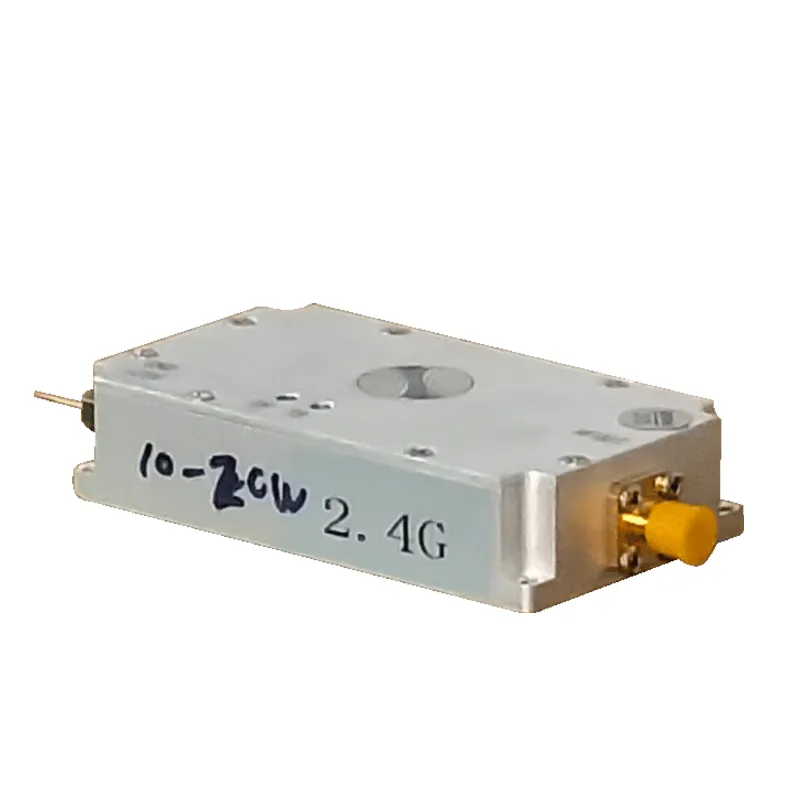
Datasheets specify CW capability explicitly, and buyers should read the fine print. A representative 100 W GaN module rated for 5150-5350 and 5725-5850 MHz delivers 50 dBm output with 45-50 dB gain at 32 V, and its CW output is specified at 100 W. A compact 10 W-class module covering 2400-2500 MHz and GNSS bands holds output at 40 dBm plus or minus 0.5 dB with 38-40 dB gain. The distinction matters because an RF power amplifier that meets a peak number in pulse mode operation may overheat when asked to sustain the same level continuously. For drone jamming, where the interference field must stay up for the whole engagement, the CW rating is the number that counts.
Sustained output turns every amplifier into a heat management problem. Modern modules built on GaN technology, the third-generation semiconductor material, dissipate heat efficiently, run at high efficiency and offer long service life, which is why they dominate high-power drone jamming designs. Internal voltage stabilization circuits keep input variations from modulating output power, and quality modules hold power stability within 1.0 dB across -40 to +55 degrees Celsius. Packaging reflects the same priorities: a 100 W module fits in roughly 170 by 94 by 26.5 mm at 0.85 kg, while the 10 W class shrinks to about 86 by 34 by 20 mm at 0.2 kg, so thermal interfaces fit handheld and vehicle housings.
An RF power amplifier never works alone. It sits behind an exciter, and in drone jamming builds that exciter is often a wideband digital signal source covering 300-6000 MHz in two bands, adjustable from +2 to -8 dBm with 2-125 MHz configurable bandwidth and ASK, PSK, FSK and CW frequency-scanning modes. A dedicated TTL interface links the source to the amplifier stage. On the output side, designers check voltage standing wave ratio, with quality modules specified at or below 1.30, and RF connectors such as SMA or N-type matched to 50 ohm lines. Gain flatness, output ripple and the enable logic, typically high-open low-close, complete the electrical interface checklist.
The practical trade-offs compress into four lines. Power rating: CW modules state a sustained wattage, while pulse mode modules state peak wattage plus a duty cycle. Thermal load: continuous operation demands heatsinks or chassis conduction, pulse operation relaxes cooling at the cost of average power. Application fit: drone jamming, calibration carriers and telemetry denial need CW; radar-style measurement favors pulse. Supply sizing: a 100 W CW module at 32 V draws about 15 A, so vehicle or battery systems must be planned around that current, while a pulse stage of the same peak power draws far less on average.
An integrator building a vehicle-mounted suppression unit started from the mission profile: six-band continuous coverage during a moving engagement, up to 30 minutes per battery charge. Selecting a CW-rated stage with GaN technology for each band, the team paired each amplifier with the wideband digital source, verified output power stability across the full -40 to +55 degree range on a thermal bench, and confirmed SWR stayed at or below 1.30 with the production antenna. The finished amplifier chain sustained rated output for the entire mission duration without throttling, something a pulse-rated alternative could not have guaranteed.
Before committing to an RF power amplifier supplier, verify five items: an explicit continuous wave rating with test data at your frequency, not just pulse mode peak figures; GaN technology construction with stated efficiency and thermal data; power stability within 1 dB across your temperature range; VSWR at or below 1.30 with standard SMA or N connectors; and customization support for bands, gain and interfaces. Suppliers that publish module-level test data and accept OEM band customization shorten integration cycles.
Which mode should I choose for drone jamming?
Choose continuous wave mode for the RF power amplifier driving a jamming transmitter. Jamming must present an uninterrupted interference field for the whole engagement, so the CW rating, not the pulse peak, defines real capability. Ask suppliers for CW test data at your exact bands before ordering.
Does duty cycle affect amplifier lifetime?
Yes. Pulse operation rests the transistors between bursts, lowering junction temperature and stress, so a pulse mode module at the same peak power runs cooler. Continuous operation at rated CW output is the harsher condition, which is why GaN technology and proper heatsinking dominate industrial designs.
What power supply does a 100 W CW module need?
Plan the RF power amplifier feed for roughly 32 V with current capacity around 15 A per module, plus headroom for the exciter and control circuits. Vehicle systems and battery packs must be sized for the continuous draw, not the average, because continuous wave mode never gives the supply a rest interval.


