
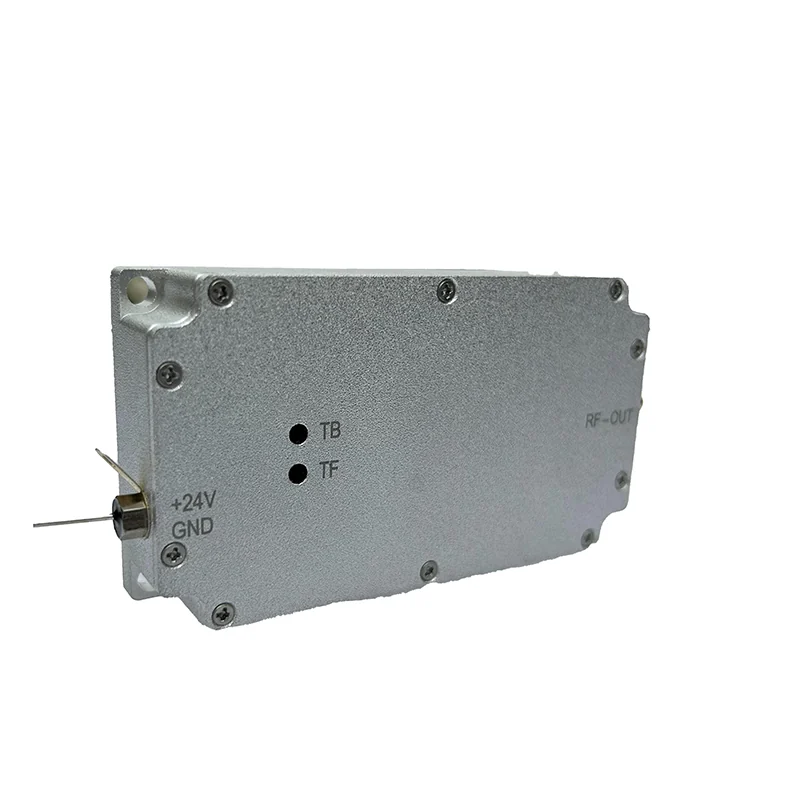
System integrators building handheld jammers, backpack units, vehicle boxes or fixed cabinets rarely design RF circuitry from scratch. The practical path is to embed a proven jamming module into a custom enclosure, power system and user interface. Done well, OEM integration turns a catalog module into a differentiated product in weeks; done poorly, it produces thermal shutdowns and failed acceptance tests. This guide walks through the electrical, RF, mechanical and control decisions that decide which outcome you get.
Signal jammer module integration begins with power. Most counter-UAS amplifier modules run from a 28 V nominal supply, with wideband signal sources accepting 12-32 V, and each module states a minimum supply current, for example 2 A for a 10 W stage and about 15 A for a 100 W continuous stage. Plan the rail with headroom, because a voltage sag during full-band transmission shows up as output instability. Sizing the supply correctly is the first thermal design decision in the project. In OEM integration, enable logic is the second contract: many modules use a high-open, low-close scheme, meaning the amplifier transmits when the control line is pulled high. Define this behavior in firmware early, wire it through a proper driver stage, and document it so field updates never accidentally key the transmitter.
The RF side of OEM integration is where prototypes fail most. Respect the signal jammer module's stated interfaces: SMA or N-type RF connectors on a 50 ohm system, and the standing wave ratio the vendor guarantees, typically 1.30 or below at the module port. Every cable, switch and antenna you add changes the match, so measure VSWR with the production antennas and RF connectors attached, not the lab calibration kit. Antenna selection then closes the loop: directional CPB antennas with 1.5-3 dBi gain suit gun-style devices, while omnidirectional fiberglass whips suit area-denial boxes; each antenna's power capacity must exceed the module's output with margin, and RF connectors in the chain must be torqued to spec. A mismatched antenna or a marginal connector rating will surface as range loss long before a failure report.
Standard modules cover the bands counter-UAS work actually needs: 420-450, 840-930, 1180-1280, 1550-1620, 2380-2470 and 5725-5850 MHz are typical; wideband sources add 300-6000 MHz excitation with 2-125 MHz configurable bandwidth. But custom devices usually serve one region with different drone frequencies. This is where frequency bands customization becomes a selection criterion: capable manufacturers adjust band edges with an efficient sweep source and support OEM customization of interfaces and control protocols. Confirm in writing which parameters are fixed silicon and which are tunable firmware, because that boundary defines your future product roadmap.
A signal jammer module is a heat source first and a component second. House it on a metal chassis or heatsink, size the contact area to the module's mounting holes, and follow the vendor's screw specification: M2.5 by 10 for compact modules, M3 by 10 for 100 W stages. Mind the published dimensions, roughly 86 by 34 by 20 mm for a 10 W module and 170 by 94 by 26.5 mm at 0.85 kg, in your enclosure layout. Verify two environmental numbers: operating temperature, with quality modules holding 1.0 dB power stability from -40 to +55 degrees Celsius, and vibration compliance, where modules built to military on-board requirements survive vehicle and backpack duty. Add forced cooling fans only when the thermal design cannot hold case temperature through natural conduction.
A regional integrator developing a wearable suppression pack learned the integration lesson in two rounds. The first prototype mounted four modules on an aluminum plate with no airflow and failed a 20-minute continuous test as output sagged with heat. The second version kept the same signal jammer module selection but added a proper thermal design fix: a conduction path to the outer shell. It also matched all antennas and RF connectors on the production harness, and moved the enable logic into a watchdog-controlled driver. The revised pack, proven in a second OEM integration round, passed the full 30-minute cycle within the 1.0 dB stability window and entered pilot service with a city security team. The hardware did not change; the integration discipline did.
Before signing with a signal jammer module supplier, verify five things. One: test reports per frequency bands option, not one representative curve. Two: stated VSWR and connector types fitting your RF connectors plan. Three: mechanical drawings with mounting holes, weight and tolerances for enclosure CAD. Four: thermal design data covering temperature stability and vibration. Five: OEM integration support: protocol customization, sample lead time and production capacity, since a module line of tens of thousands of units per year protects your delivery schedule. Suppliers offering full-process training and scheme design assistance further de-risk the program.
Can I change the frequencies of a jammer module after purchase?
Band edges set by an efficient sweep source are usually customizable in firmware, and many manufacturers retune modules for regional requirements during OEM integration, but fixed-circuit designs cannot be altered. Ask which frequency bands are tunable before you lock the bill of materials.
Why did my prototype lose range compared with the datasheet?
In most cases the module is fine and the RF path is not. A VSWR above the specified 1.30 caused by cable loss, a marginal RF connectors joint or an unmatched antenna will cut effective range sharply. Re-measure the match with the production antenna before blaming the module.
What should I provide the supplier for a custom build?
Bring your target frequency bands list, duty cycle and mission duration, enclosure constraints including dimensions and cooling method, and your control interface, such as TTL or RS-485. Suppliers can then propose the right signal jammer module class, source pairing and protocol customization in one OEM integration round.


