
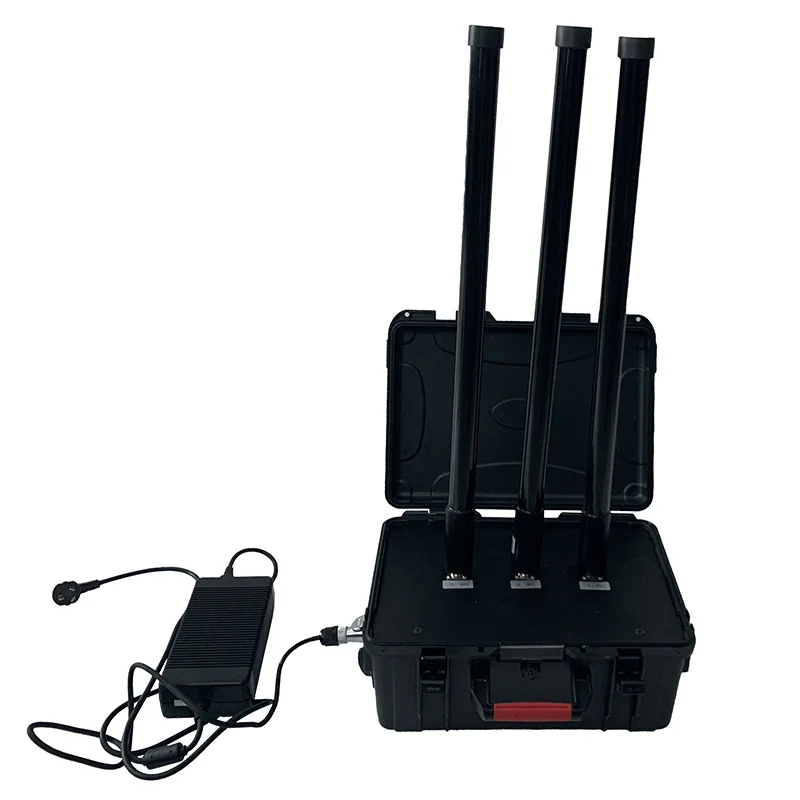
Facility managers evaluating anti drone systems quickly meet a menu of counter drone options: net capture, kinetic interceptors, directed energy, GNSS spoofing and RF denial. Budgets are finite and procurement teams need a defensible default. Across airports, prisons, power plants and public events, RF denial keeps winning that default role, and this guide explains why it remains the backbone, how it pairs with drone detection, where it genuinely falls short, and how to verify a jamming-based design before purchase.
Signal jamming works by hitting the radio links a drone depends on with sustained RF interference: satellite positioning, remote control and video transmission. Nothing is destroyed, no debris falls on a crowd, and the engagement is repeatable at zero marginal cost. Compare that with kinetic options, which demand expensive per-engagement consumables and create fallout liability over populated areas. Reversibility also simplifies the legal and safety review that every counter drone program must pass, because a suppressed drone that lands or returns home is an evidentiary asset rather than a hazard.
Intrusion timelines are short. A drone crossing a 2 km perimeter at 15 m/s gives defenders roughly two minutes. A channelized jamming unit responds within about three seconds of a confirmed drone detection and delivers roughly 50 W per channel across bands such as 900 MHz, 1.2 GHz, 1.5 GHz, 2.4 GHz, 5.2 GHz and 5.8 GHz, with customizable coverage from about 220 MHz up to 5.86 GHz for modified aircraft. Independent channel switching lets operators match the response to the threat instead of flooding the spectrum, and robust designs sustain at least 15 simultaneous targets during swarm-style incidents. This is why signal jamming scales across sites and fleets: no other countermeasure family combines this response speed with per-engagement economics, and in modern anti drone systems it is the layer that carries the default load.
Jamming should never fire blind. The detection layer, usually a passive drone detection system scanning from tens of megahertz to 6 GHz, identifies the intruder and its bearing first; networked nodes extend this to 3-10 km with positioning accuracy at or above 99 percent recognition. Only after the software confirms a target does the jammer engage, and only on the bands the target actually uses. This detect-then-respond chain is what keeps RF interference contained and makes every engagement reproducible in an incident log.
Trustworthy planning means stating where signal jamming stops working. Tethered and fiber-optic-guided drones carry no RF link to attack. Frequency-hopping aircraft need bands customized beyond the standard six, which capable suppliers support from roughly 220 MHz to 5.86 GHz. Dense urban RF environments shorten effective range, and jamming is regulated in most markets, so operating authority and licensing must be confirmed before deployment. Mature counter drone programs therefore treat jamming as the default layer and add GNSS spoofing units, optical tracking or physical barriers where the threat profile demands them.
A contractor integrating anti drone systems for executive motorcades fielded a vehicle-mounted detection and jamming platform specified for 3 km jamming radius, 5 km passive detection and full operation at convoy speeds up to 150 km/h. During acceptance trials the drone detection layer flagged an approaching test drone within five seconds, classified it, and forced it to return to home while the convoy kept moving. The six jamming channels covering 840 MHz through 5.88 GHz handled every consumer protocol presented to it, and each engagement appeared in the mission log. The contractor selected RF interference suppression precisely because the same hardware serves convoy, static site and temporary event missions without restocking.
When shortlisting anti drone systems built around signal jamming, request four proofs. First, per-channel output power and antenna pattern data, not a single aggregated wattage. Second, measured response time from drone detection confirmation to transmission. Third, evidence that bands are customizable for regional and modified-drone frequencies. Fourth, environmental ratings such as IP66 and temperature ranges matching your deployment climate. Suppliers who publish this data, as the modular jammer and detection hardware designed for counter drone integration typically do, will also support ODM customization and operator training, which shortens commissioning.
Is signal jamming legal for private security teams?
Regulation varies by country. In most markets RF jamming is restricted to authorized government or critical-infrastructure operators, and imports may require licensing. Buyers should confirm operating authority with their national regulator before adding jamming-based anti drone systems to a tender.
Does jamming damage the drone or its payload?
No. Signal jamming is temporary RF interference. Once transmission stops, the drone's receivers recover, and captured aircraft are usually intact enough for forensic inspection. This is a core advantage over kinetic counter drone options when evidence preservation matters.
How is jamming different from GNSS spoofing?
Jamming denies all links by raising the noise floor, forcing a failsafe such as hover or return-to-home. Spoofing feeds counterfeit navigation data to steer the aircraft to a chosen safe zone. Many anti drone systems combine both, using jamming as the broad response and spoofing when a controlled redirection is preferred.


