
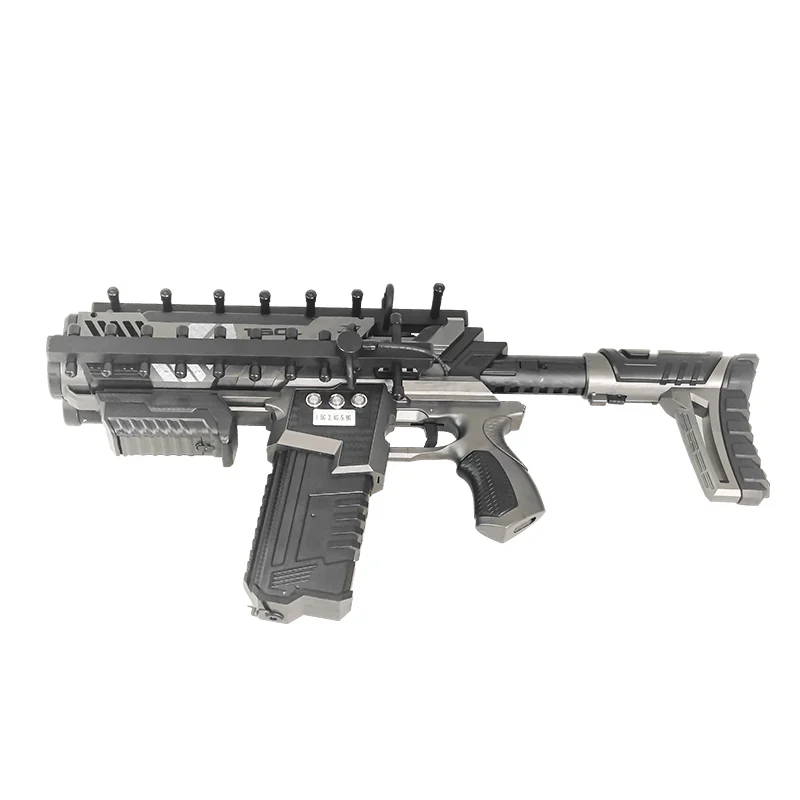
The first question security buyers ask about a portable countermeasure is simple: can one device cut a drone's GNSS signals and its control signals at the same time, or must the operator choose one and accept the risk? The short answer is yes, simultaneous suppression is standard practice, provided the gun uses independent RF channels for each band. This guide explains how that works, what happens to the target drone, and which specifications separate a capable unit from a toy.
Every consumer and FPV drone flies on three links at once. GNSS signals, received in bands such as 1550-1620 MHz, tell the aircraft where it is. Control signals, commonly carried at 840-930 MHz or 2400-2500 MHz, carry the pilot's commands. The video downlink, typically at 5150-5350 MHz or 5725-5850 MHz, sends the camera feed back to the pilot. Cut positioning only and the drone keeps flying its mission on autopilot; cut commands only and it still streams footage and loiters. Only simultaneous suppression across all three links produces the desired outcome: the aircraft loses its position reference, its commands and its eyes at the same moment, then triggers a failsafe such as hover, return-to-home or a controlled descent.
This architecture solves the problem with independent channels. A representative six-channel design covers 430-450 MHz, 860-930 MHz, 1160-1280 MHz, 1560-1620 MHz, 2380-2470 MHz and 5725-5850 MHz, with output power between 10 W and 30 W per channel. Because each channel has its own amplifier path, the drone jammer can attack GNSS signals and control signals simultaneously without the channels interfering with each other. Independent on-off control per band matters in the field: an operator facing a modified FPV drone on 1.2 GHz activates that channel alone, while a standard consumer drone may need the full set. Independent switching also lets a stadium detail keep the video downlink channel off when broadcast links are live. Coverage of this kind handles mainstream platforms as well as racing and custom-built aircraft.
The RF channels are only half the story. A directional CPB antenna with 1.5-3 dBi gain concentrates energy toward the target, extends effective range and reduces collateral interference around the operator. The pattern concentrates energy on the target instead of flooding nearby control signals and broadcast receivers. Standing wave ratio should stay at or below 2.0 with a power capacity near 200 W so the antenna survives continuous transmission. On the electrical side, a 28 V battery pack feeding a draw of no more than 300 W with efficiency of 50 percent or better keeps a 10 kg-class unit shoulder-fired and mobile. This is what separates a fieldable drone jammer from a bench experiment: the energy budget must support repeated engagements across a full shift.
When all channels fire, the aircraft loses its GNSS signals first, then its control signals, then its video downlink. Flight controllers respond in a predictable hierarchy: hover in place, attempt return-to-home on dead reckoning, or execute an automatic landing. Expectations should be set by numbers, not hope. Effective range for a handheld directional unit typically falls between 1 and 3 km depending on the drone and the RF environment, continuous jamming runs about 30 minutes per battery, and a robust design handles at least 15 simultaneous targets during a swarm incident. Field durability matters just as much: an IP65 housing, operation from -30 to 70 degrees Celsius, a touchscreen with physical buttons for gloved use, and hot-swappable batteries keep the anti drone gun on mission time instead of a recharge countdown.
At a large outdoor event, a security team deployed a six-channel handheld unit at a corner of the stands. When an unauthorized drone circled the venue, the operator engaged the GNSS signals, control signals and video channels together; the aircraft entered a failsafe hover and descended short of the crowd line. The directional pattern meant broadcast and cellular links around the venue stayed unaffected. The team later standardized on the same anti drone gun for motorcade details, citing the sub-10 kg weight and single-operator workflow.
When comparing models, verify per-band channel independence across control signals and video downlink coverage, per-channel output power, antenna standing wave ratio, battery swap workflow and stated range for the drone jammer under realistic conditions. Legal review matters too: RF jamming is regulated in most markets, so confirm which agencies may operate the device and what licensing steps apply. A supplier that documents test data per channel and offers training will shorten deployment time significantly.
How far can an anti drone gun reach?
Handheld directional units typically achieve 1-3 km against mainstream consumer drones. Range shortens on congested video downlink bands, against hardened targets and in cluttered RF environments, so buyers should request per-channel test data rather than a single headline number from the drone jammer datasheet.
Does blocking GPS damage the drone?
No. Suppression is reversible interference, not physical destruction. Once transmission stops, the aircraft regains its GNSS signals and receivers. Most drones respond to a total link loss by hovering or landing, which is exactly the controlled outcome an anti drone gun is designed to produce.
Can one operator really run it alone?
Yes. Gun-style units in the 6-10 kg class are designed for shoulder-fired, single-operator use, with aiming aids such as an optical scope and simple channel toggles. Training takes hours, not weeks, which is why patrol teams favor this form factor.
Can it stop a drone that uses a fiber-optic tether?
No. A drone jammer works only against aircraft that rely on radio links. Tethered or fiber-guided platforms require other countermeasures, which is why an anti drone gun is one layer of a defense plan, not the whole plan.


